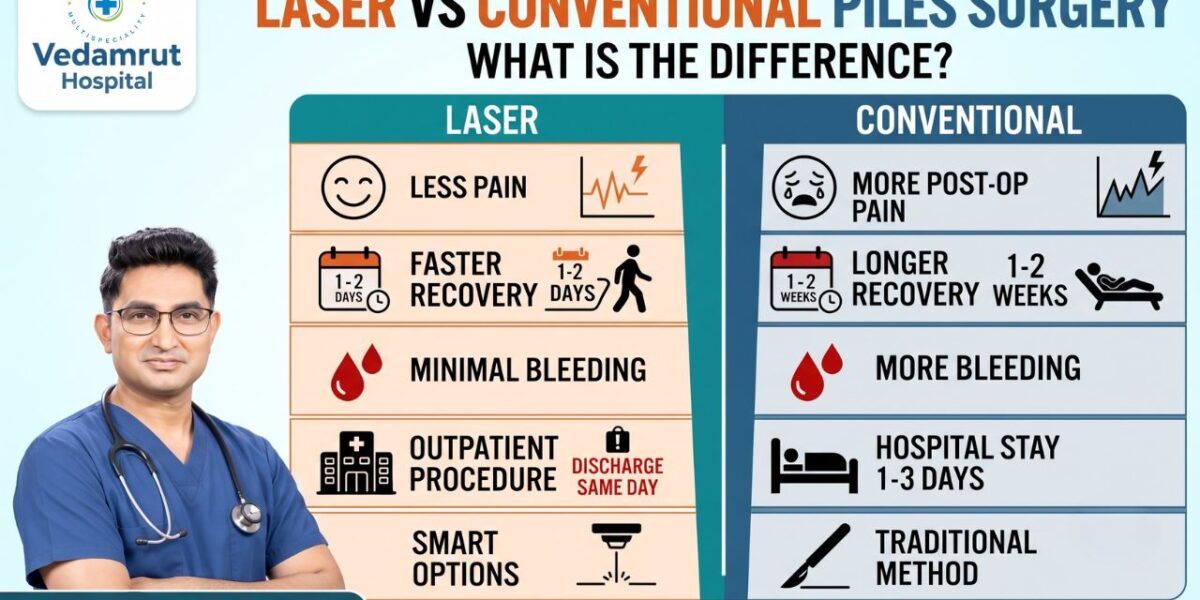
If your doctor has said you may need piles surgery, one question usually follows quickly: should you choose laser or conventional surgery? Online, laser is often described as painless and permanent. The reality is more nuanced. Both procedures have a place, and the right choice depends on your type of piles, their grade and your examination findings.
This guide explains the real differences in plain language, so you can have an informed conversation with your surgeon.
What Is Piles Surgery and When Is It Needed?
Not everyone with piles (hemorrhoids) needs an operation. Many patients improve with diet changes, fibre, adequate water, medicines and office-based procedures such as rubber band ligation. Grade I and II internal piles, and some Grade III, are often managed this way first.
Piles surgery is usually considered when:
- Bleeding or prolapse keeps returning despite treatment
- Piles are large, Grade III or Grade IV
- There is a significant external component
- Pain, discomfort or hygiene problems affect daily life
- Earlier treatments have not worked
Your surgeon will weigh symptoms, grade, prolapse, previous treatment and your overall health before recommending anything. If you are in Thane or nearby, you can read more about piles treatment at Vedamrut.
What Is Laser Piles Surgery?
Laser piles surgery, medically called laser hemorrhoidoplasty (LHP), uses a thin laser fibre to deliver energy into the hemorrhoidal tissue. The aim is to shrink and coagulate the tissue rather than cut it out.
It is worth knowing that “laser surgery” is not one single standard procedure. You may hear it called laser hemorrhoid treatment, laser coagulation, the Hemorrhoidal Laser Procedure (HeLP) or, sometimes, laser hemorrhoidectomy. Techniques vary between surgeons, and recent clinical recommendations have called for greater standardisation. Ask your doctor exactly what will be done in your case.
What Is Conventional Piles Surgery?
Conventional surgery is called hemorrhoidectomy. The surgeon removes (excises) the hemorrhoidal tissue. The two common techniques are:
- Open (Milligan-Morgan) hemorrhoidectomy: the surgical wounds are left open to heal.
- Closed (Ferguson) hemorrhoidectomy: the wounds are stitched closed.
This is the long-established treatment for advanced piles, and current guidelines continue to support it for selected patients, especially those with external piles or combined internal and external piles with significant prolapse.
Laser vs Conventional Piles Surgery: Key Differences
These three conditions are often confused because all of them affect the anal region and can cause bleeding or discomfort.
|
Factor
|
Laser Hemorrhoidoplasty
|
Conventional Hemorrhoidectomy
|
|---|---|---|
|
Basic approach
|
Shrinks/coagulates hemorrhoidal tissue
|
Removes hemorrhoidal tissue
|
|
Tissue removal
|
Usually limited
|
More extensive
|
|
Postoperative pain
|
Generally lower
|
Generally higher
|
|
Bleeding
|
Generally lower
|
Can be higher
|
|
Recovery
|
Usually faster
|
Usually longer
|
|
Return to activities
|
Usually earlier
|
Usually later
|
|
Wound
|
Limited tissue injury
|
Surgical wound
|
|
Long-term durability
|
Evidence still developing
|
Well established
|
|
Advanced external disease
|
May not be ideal
|
Often more suitable
|
|
Grade III–IV disease
|
Careful patient selection needed
|
Often considered, especially with external component
|
|
Recurrence
|
Needs discussion
|
Generally durable, though recurrence is still possible
|
The right procedure depends on the type and grade of your piles, any external component, prolapse, symptoms and examination findings. Laser is not automatically better for every patient.
Which Is More Painful: Laser or Conventional Piles Surgery?
Conventional surgery removes tissue, so some pain after piles surgery is expected, and the first few bowel movements can be uncomfortable. Laser causes less tissue trauma, and patients usually report less pain in the early recovery period.
Studies support this. A 2024 meta-analysis of 17 studies and 1,196 patients found lower postoperative pain and bleeding with laser hemorrhoidoplasty than with conventional hemorrhoidectomy. A 2026 systematic review of 15 randomised trials also found lower pain on days 1 and 7 after laser.
Recovery After Laser vs Conventional Piles Surgery
Recovery varies from person to person, so be cautious about any clinic promising a fixed number of days. In general:
- After laser: many patients return to light daily activity and work sooner, and walking and sitting are often easier in the first days.
- After conventional surgery: recovery is usually longer, and wound healing continues for several weeks, with more rest advised early on.
Research shows an earlier return to work and daily activities after laser in several studies. Your own timeline depends on the procedure, your job, your general health and how well you follow aftercare, including a high-fibre diet, hydration, prescribed medicines and follow-up visits. Your surgeon should give you specific guidance on when to walk, sit, exercise and resume work.
Which Has Less Bleeding?
Comparative studies generally report less postoperative bleeding with laser than with conventional hemorrhoidectomy. Some spotting is normal after any piles procedure, but heavy bleeding, clots or dizziness need urgent medical attention.
Which Is Better for Grade 2 Piles?
Many Grade II piles respond to diet, medicines or office procedures such as rubber band ligation, so surgery is often not the first step. When symptoms persist, a minimally invasive option such as laser may be suitable. Your surgeon will examine you before advising.
Which Is Better for Grade 3 Piles?
Grade III piles prolapse and must be pushed back in. This grade does not automatically mean “laser” or “open surgery.” Selected cases can be treated with minimally invasive techniques, while others, especially those with large prolapse or an external component, may do better with conventional surgery. Studies have compared laser and conventional surgery in Grade II/III disease, but the decision still rests on your individual anatomy. Read more about Grade 3 and Grade 4 piles treatment.
What About Grade 4 Piles?
Grade IV piles remain prolapsed and cannot be pushed back. They usually need surgery, and current guidance states that Grade IV internal hemorrhoids require surgical hemorrhoidectomy. Recent reviews note that the limitations of laser become more apparent in advanced disease, with higher recurrence concerns in Grade IV. So the honest answer to “can Grade 4 piles be treated with laser?” is: rarely the best choice, and only after careful assessment.
Is Laser Piles Surgery Suitable for External Piles?
Laser mainly acts on internal hemorrhoidal tissue. External piles, or combined internal and external piles with significant skin tags or prolapse, often need excision. This is one of the main reasons your surgeon may recommend conventional surgery even when you ask for laser.
Frequently Asked Questions
Laser shrinks and coagulates hemorrhoidal tissue with limited tissue removal. Conventional surgery removes the tissue.
It can mean less early pain, less bleeding and quicker recovery in suitable patients. Conventional surgery may be better for advanced or external piles, and its long-term results are better established.
Laser is generally less painful in comparative studies, although no procedure is pain-free.
Laser is generally less painful in comparative studies, although no procedure is pain-free.
Laser usually allows an earlier return to daily activities, but recovery varies by person.
Sometimes, in selected cases. Large prolapse or an external component may favour conventional surgery
Grade IV piles usually need surgical hemorrhoidectomy, and laser has limitations in advanced disease.
Usually not on its own. External or combined piles often need excision.
Yes, piles can recur after any surgery. Long-term durability of laser is less certain than for conventional surgery.
Possible effects include pain, bleeding, swelling, urinary difficulty, thrombosis, infection and recurrence.
It varies. Laser recovery is usually quicker; conventional surgery takes longer, with wound healing over several weeks.
It depends on the hospital, surgeon, grade, admission and follow-up. Request an estimate after your examination.
Many procedures are done as day care or with a short stay, depending on the procedure and your health.
Yes. Many Grade I–II and selected Grade III piles improve with lifestyle changes, medicines or office procedures such as rubber band ligation.
None is best for everyone. The choice depends on your grade, prolapse and external disease.
Can Piles Come Back After Surgery? Is Laser Permanent?
No surgery can promise that piles will never return. Treated tissue can be dealt with effectively, but hemorrhoidal symptoms can still recur, particularly if constipation, straining and long toilet sittings continue.
Long-term durability appears less certain for laser than for established excisional surgery. A 2026 systematic review described a trade-off: better short-term recovery with laser, but uncertainty about long-term results because of limited follow-up and low-certainty evidence. Be wary of any claim that laser “permanently cures” piles.
Laser Piles Surgery Side Effects and Risks
Complications are not common, but possible concerns after laser piles surgery include:
- Pain or discomfort
- Bleeding
- Swelling
- Difficulty passing urine
- Thrombosis (a clot in a hemorrhoid)
- Infection
- Recurrence or incomplete symptom relief
- The need for further treatment
Conventional surgery carries similar risks, with a longer healing period. Your surgeon should discuss the risks that apply to you.
Laser vs Conventional Piles Surgery Cost
There is no single price. The cost of piles surgery in India, including Mumbai and Thane, depends on:
- The procedure and grade of piles
- Hospital and surgeon
- Anaesthesia and investigations
- Day-care or overnight admission
- Medicines and follow-up visits
- Complications, if any
- Insurance coverage
Advertised prices vary widely, which is why a fixed figure can mislead. For an estimate based on your case, see our piles surgery cost guide or contact the Vedamrut team.
Is Laser Piles Surgery Really Painless?
Not entirely. Laser is generally linked with less postoperative pain than conventional hemorrhoidectomy, but no surgery should be promised as 100% painless. Expect some discomfort, which is usually manageable with prescribed medicines and good bowel habits.
How Does a Doctor Decide Which Piles Surgery Is Right for You?
Your surgeon will consider the grade and type of piles (internal, external or combined), degree of prolapse, bleeding and pain, previous treatments, other anal conditions and your overall health and work needs. The decision should be based on your anatomy, not on the word “laser.”
Questions to Ask Your Piles Surgeon
- Which grade and type of piles do I have?
- Do I really need surgery, or can I try other treatment first?
- Why do you recommend this procedure for me?
- What are the risks, and what is the chance of recurrence?
- How long will recovery take, and when can I return to work?
- What is the total cost, including follow-up?
Conclusion
Laser piles surgery offers real advantages in selected patients: less early pain, less bleeding and faster recovery. Conventional hemorrhoidectomy remains the established, durable option for advanced, external or combined piles. The best choice is the one matched to your anatomy and symptoms after a proper examination.
If you are considering piles surgery, book a consultation at Vedamrut Hospital for a personalised assessment and a clear explanation of your options.
Disclaimer: This article is for general information and does not replace medical advice. Please consult a qualified surgeon for diagnosis and treatment.