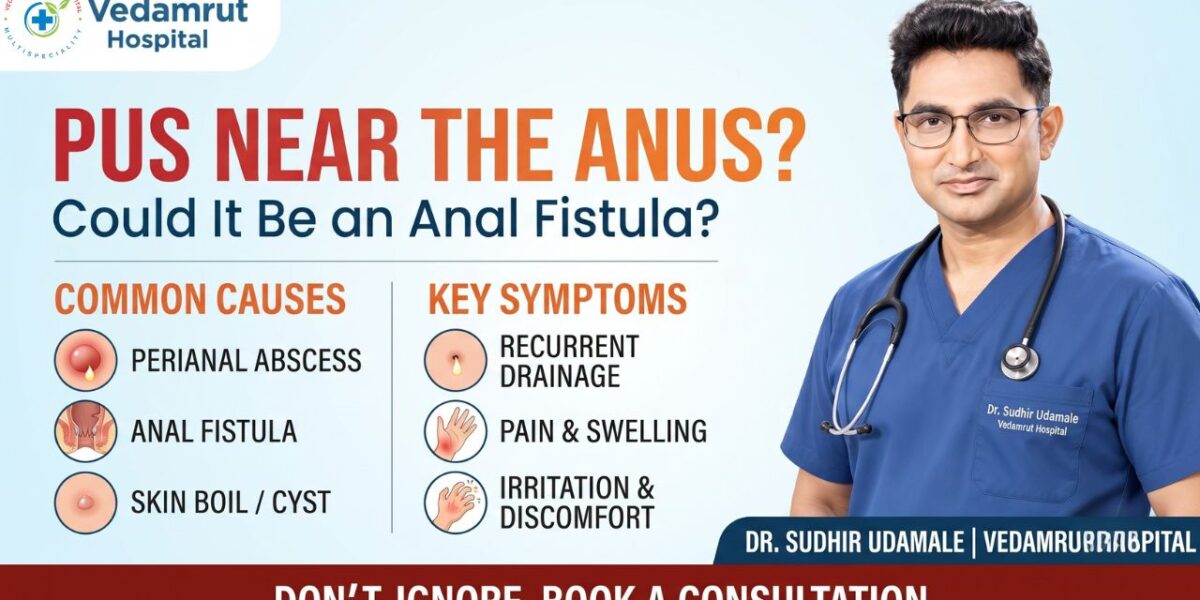
Noticing pus near your anus is worrying, and many people put off seeing a doctor out of embarrassment. Pus near the anus can have several causes, including an anal abscess, an infected boil or an anal fistula. If pus keeps draining from the same small opening, especially after a previous abscess, an anal fistula is an important possibility.
This guide explains what pus near the anus can mean, how to tell the possible causes apart, and what treatment involves.
What Does Pus Near the Anus Mean?
Pus is a sign of infection. Common causes of pus near the anal opening include:
- Perianal abscess: a painful collection of pus under the skin near the anus.
- Anal fistula: a persistent tunnel that can develop after an abscess drains.
- Infected skin boil or cyst: a one-time skin infection that is not connected to the anal canal.
- Recurrent abscess: repeated swelling and drainage in the same area.
- Other anorectal conditions: less commonly, conditions such as Crohn’s disease.
Pus alone does not confirm a fistula. Only a clinical examination can tell what is causing it.
What Is an Anal Fistula?
An anal fistula (also called fistula-in-ano, perianal fistula or anorectal fistula) is an abnormal tunnel connecting the inside of the anal canal or rectum to the skin around the anus. It has an internal opening inside the anal canal and an external opening on the skin, which often looks like a small hole.
Why Does an Anal Fistula Develop?
Most anal fistulas follow a simple sequence:
Anal gland infection → abscess → pus collection → abscess drains → persistent tract → anal fistula
Small glands inside the anal canal can become blocked and infected, forming an abscess. Once the abscess bursts or is drained, a channel may remain and keep draining. Crohn’s disease and certain infections can also lead to fistulas.
Pus Near the Anus: When Could It Be a Fistula?
A fistula becomes more likely when you notice:
- Pus draining repeatedly from the same spot
- A small hole or opening near the anus
- A painful lump that keeps coming back
- A previous abscess that never fully settled
- Foul-smelling or blood-stained discharge
- Pain that eases after drainage and returns later
- Skin irritation around the opening
A one-time boil is not automatically a fistula. But repeated drainage from the same opening deserves medical assessment.
Anal Fistula Symptoms You Should Know
Anal Fistula Common symptoms include:
- Pus or blood-stained discharge
- Persistent or recurring pain, often worse when sitting or passing stool
- Swelling and redness near the anus
- Skin irritation or itching
- Foul-smelling discharge
- Recurrent abscesses
- Fever, when an abscess or infection is active
What Does a Small Hole Near the Anus Mean?
A small skin opening near the anus can be the external opening of a fistula, particularly if it leaks pus or you have had an abscess before. However, appearance alone cannot diagnose it. Other conditions can cause skin openings, so a doctor needs to examine the area and trace where any tract leads.
Anal Abscess vs Anal Fistula: What's the Difference?
These three conditions are often confused because all of them affect the anal region and can cause bleeding or discomfort.
|
Details
|
Anal abscess
|
Anal fistula
|
|---|---|---|
|
What it is
|
A collection of pus
|
An abnormal tunnel (tract)
|
|
Onset
|
Usually acute
|
Often develops after an abscess
|
|
Typical feature
|
Painful, swollen lump
|
Recurrent or persistent drainage
|
|
Treatment
|
Assessment and often drainage
|
Usually needs definitive treatment
|
An abscess can lead to a fistula, and a fistula can cause recurrent abscesses
Anal Fistula vs Piles vs Fissure
These conditions overlap, but some patterns help:
- Fistula: pus, recurrent drainage, a small external opening, recurrent abscess.
- Piles: bright-red bleeding and swelling, but pus is not typical.
- Fissure: sharp pain during stool, sometimes with bright-red blood, but usually no lump or pus.
Because symptoms overlap, examination is needed for a correct diagnosis.
Can an Anal Fistula Heal on Its Own?
Most anal fistulas do not reliably heal on their own and usually need a procedure or Anal Fistula Surgery. Drainage may ease for a while, but the underlying tract typically remains.
What Happens If the Pus Stops Coming Out?
Many people assume that when the discharge stops, the problem is gone. In reality, the external opening can close temporarily while the tract underneath remains. Pus can then build up again, causing pain and swelling until it drains once more. If you have had this cycle, get it checked.
Can Antibiotics Cure an Anal Fistula?
Antibiotics may be used when there is infection, but they generally cannot eliminate the fistula tract itself. If an abscess is present, drainage is often necessary. Treating the fistula usually requires a procedure chosen according to its anatomy.
How Is an Anal Fistula Diagnosed?
Diagnosis usually involves:
- Medical history: previous abscesses, bowel habits, Crohn’s disease.
- Physical examination: inspection of the external opening and surrounding skin.
- Digital rectal examination or anoscopy, where appropriate.
- Imaging in selected or complex cases: MRI pelvis, endoanal ultrasound or, occasionally, CT.
When Is an MRI Needed for Anal Fistula?
An MRI helps the surgeon map the fistula. It shows where the tract begins and ends, whether it branches, whether a hidden abscess is present and how much sphincter muscle is involved. This is especially useful for recurrent, branching or complex fistulas, and it reduces the chance of missing part of the tract.
FAQs About Pus Near the Anus and Anal Fistula
Not necessarily. It may be an abscess or an infected boil. Recurrent pus from the same spot makes a fistula more likely, but only an examination can confirm it.
Common causes are an infected anal gland causing an abscess, a skin boil, an anal fistula and, less often, conditions such as Crohn's disease.
Warning signs include repeated drainage from a small opening, recurrent abscesses and pain that returns after the discharge stops. A doctor's examination is needed to confirm.
It can be the external opening of a fistula, especially with discharge or a past abscess, but it needs medical examination.
Yes. A fistula often develops after an abscess drains, and a persistent tract remains.
Usually not reliably. Most need a procedure or surgery.
Antibiotics can treat infection but generally do not remove the tract.
Most fistulas need a procedure for definitive treatment. The type depends on the anatomy.
There is no single best option. The right choice depends on the fistula's position, complexity and sphincter involvement.
It can be suitable for selected cases, but it is not the best option for everyone, and evidence on its success is still evolving.
Not always, but MRI is useful for complex, recurrent or branching fistulas.
Yes, recurrence is possible, particularly with complex tracts.
There is a risk if sphincter muscle is damaged, which is why treatment is planned to protect it.
It can cause recurring abscesses, ongoing discharge and pain, and it may become more complex.
Anal Fistula Treatment Options
The right treatment depends on the fistula’s position, number of tracts, sphincter involvement, previous surgeries, continence status and any associated Crohn’s disease.
Fistulotomy
The tract is opened and allowed to heal from the inside out. It is a common option for suitable low or simple fistulas.
Seton Placement
A thin thread or drain is placed through the tract. It is used when significant sphincter muscle is involved or when staged treatment is safer.
LIFT Procedure
LIFT (ligation of the intersphincteric fistula tract) is a sphincter-preserving technique for selected fistulas.
Advancement Flap
A flap of healthy tissue covers the internal opening. It may be considered for certain complex fistulas where cutting the muscle could threaten continence.
Laser Fistula Treatment / FiLaC
FiLaC (fistula laser closure) is a minimally invasive, sphincter-sparing technique used in selected cases. Laser treatment is one option among several, and it is not automatically the best choice for every patient. Outcomes depend on the fistula’s anatomy and on the surgeon’s assessment, and the evidence on how well it works is still developing.
Does Fistula Surgery Affect Bowel Control?
The anal sphincter muscles control continence, so the goal of treatment is to heal the fistula while protecting these muscles. The simplest-looking procedure is not necessarily the safest for every fistula. This is why a thorough assessment comes before choosing a technique, and why different patients receive different treatments. As with any surgery, complications are possible, and your surgeon should discuss the risks with you beforehand.
Can an Anal Fistula Come Back After Treatment?
Recurrence is possible. Branching or complex tracts, an undetected secondary tract, and underlying conditions can all raise the risk. Careful mapping, the right procedure for your anatomy and regular follow-up all help lower it.
What Happens If an Anal Fistula Is Left Untreated?
Untreated fistulas can cause ongoing discharge, repeated abscesses, persistent pain and skin irritation, and they can become more complex over time. Early assessment generally gives more options.
When Should You See a Fistula Specialist?
Book an appointment with a colorectal surgeon or proctologist if you have:
- Pus near the anus for more than a few days
- A small hole near the anus that keeps draining
- A recurring boil or abscess in the same area
- Pain, swelling, fever or foul-smelling discharge
Seek urgent care for severe pain, high fever or rapidly spreading redness.
At Vedamrut, Thane, our approach is doctor-led rather than procedure-led: accurate diagnosis first, then a treatment plan matched to your anatomy. Book a consultation → (link to appointment page)
Conclusion
Laser piles surgery offers real advantages in selected patients: less early pain, less bleeding and faster recovery. Conventional hemorrhoidectomy remains the established, durable option for advanced, external or combined piles. The best choice is the one matched to your anatomy and symptoms after a proper examination.
If you are considering piles surgery, book a consultation at Vedamrut Hospital for a personalised assessment and a clear explanation of your options.
Disclaimer: This article is for general information and does not replace medical advice. Please consult a qualified surgeon for diagnosis and treatment.